
 Methodist Rehabilitation Center
December 21, 2009
2009 was to be the year that Karen and Paul Hasley said good-bye to worried vigils in hospital waiting rooms.
Their son Shane had endured the last of 10 surgeries to correct his congenitally deformed feet, and life was looking up for the outgoing Ocean Springs High School senior.
Then came the Feb. 24 phone call that sent the couple rushing to Ocean Springs Hospital. The 18-year-old had flipped his truck and suffered a life-threatening brain injury.
Preliminary tests revealed little or no activity in both frontal lobes of the brain, and doctors doubted Shane could survive. But his parents refused to give up hope.
“I leaned down and whispered in his ear, ‘Shane, you are going to have to fight harder than you’ve ever fought in your entire life,’ ” remembers Karen.
“Take a seat,” Paul told the doctors. “You are about to witness a miracle.”
Today, the Hasleys are in awe of the progress their son has made. After months of therapy at Methodist Rehabilitation Center in Jackson, Shane is taking high school courses at home. He hopes to be back in the classroom come fall.
“I will never tell anyone there is no such thing as miracles,” Karen says. “If we had not made the trip to Methodist … I think he would have been bedridden for the rest of his life.”
Shane is used to overcoming the odds. He underwent his first surgery at age 6 months, and his mom says: “He never wanted help from anybody.”
But even she worried whether her son had the resiliency to face a post-accident setback that was particularly heartbreaking. While Shane was still unconscious, medication used to regulate his blood pressure collapsed blood vessels in his left foot. Doctors had no choice but to amputate.
“That was very difficult,” recalls Karen. “After everything he has been through – to lose that left leg. But it came down to his life or the limb.”
When Shane transferred to Methodist Rehab on May 26, he arrived unable to sit up on his own, and he had a tracheotomy and a feeding tube. The normally talkative teen also had not spoken in three months.
“When they asked me what my goal was for him, I told them, ‘I just want to hear his voice,’” Karen said. “He has never met a stranger. To go from being so outgoing to not talking, it was so strange.”
Dr. Zoraya Parrilla, medical director of Methodist Rehab’s Traumatic Brain Injury Program, evaluated Shane and decided to administer Amantadine, a psycho-stimulant medication that can increase brain activity.
“Amantadine is a powerful stimulant and it’s my first choice in cases like Shane’s where a patient is minimally conscious,” Dr. Parrilla said. “I could see a strong correlation between the time when the agent was initially given and the time when Shane responded. The results in this case were remarkable.”
After almost three weeks, Shane still appeared unresponsive and physical therapist, Katie Daniels, had to push hard to draw any kind of response.
“Shane always wore a hat,” explained Daniels. “One afternoon, I took his hat and put it over his face. I told him, ‘Shane, if you don’t like this then you need to do something about it.’”
Daniels watched as Shane reached up, grabbed the hat, and replaced it on his head. It was the breakthrough everyone had been praying for. “That was when I knew we were finally reaching him,” Daniels said.
Soon after, Karen began to notice small improvements in her son every day. One afternoon, a therapist informed Karen that she needed to come to the therapy room right away. “I was nervous,” she remembers. “I didn’t know what to expect.”
When Karen walked into the room, she overheard speech therapist Holly Radicioni ask, “Shane, what is your mother’s name?”
“Mom,” he replied.
“What is your father’s name?”
“Dad.”
Two months prior to his accident, the family adopted a new puppy. Since the accident affected much of Shane’s short-term memory, Karen was curious if he remembered the dog’s name. “I leaned over to Holly and said, ‘Ask him what the dog’s name is.’”
Without hesitation, Shane replied, “Desiree.”
“I lost it at that point,” his mom recalls. “He was back. And once he started talking, he had three months of silence to make up for.”
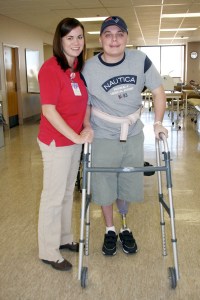
Shane is now able to breathe and eat on his own. He has also received a prosthetic leg from Methodist Orthotics & Prosthetics and is undergoing intense physical therapy to build up his strength so that he can progress to getting around with a walker.
It will be a long, hard road, but Shane remains optimistic about the future. He is working on completing his school curriculum and hopes to graduate from Ocean Springs High School next year.
“When this is all over,” he says, “I want to become a professional fisherman or a game warden.”
 Lisa L. Bynum - Writer + Blogger + Virtual Assistant