
One Stroke at a Time: Jerrine Querin

Stages Magazine
March/April 2010

It’s ten o’clock at night and while most people are thinking about heading to bed, artist Jerrine Querin is heading into the studio at her Belhaven home.  The Jackson native has been known to paint into the wee hours of the morning, often completing the last brush stroke at five a.m.

“That is my time,” she reveals.  “I get going and really get involved in a painting and I lose track of the rest of the world.”

Querin has been painting for 15 years.  Getting her start in watercolors, the self-taught artist began painting in oils eight years ago.  “I love the way oil paintings add warmth to a wall,” she says.  “I like the look of a brush stroke on a painting.”  When asked where she draws her inspiration, Querin replies, “When you paint, you look at the world differently.  I might be driving down the road and suddenly notice the clouds or the shape of a tree.  Before I began painting I never took the time to notice the clouds.”  Querin considers herself to be a colorist when it comes to her work.  Colorist artists produce vibrant, richly-hued paintings that impart the perception that the world is a richer, more beautiful place than we can see in our day-to-day lives.  Adds Querin, “I love colorful landscapes.  In my paintings, you will never see just a tree with green leaves and a brown trunk.”

Querin utilizes the Alla Prima style of painting.  This technique requires that a canvas be completed while the paint is still wet, rather than building colors on a canvas by adding layers of paint or by glazing over an underpainting.  In other words, an Alla Prima painting is started and completed in one session.  Each brush stroke is final with no retouching afterwards.   The result is a work of art with a spontaneous feeling that is completed during the artist’s inspiration.

“Many people assume that painting is a great way to relax, but it’s actually more about solving problems,” Querin says.  “Setting up your composition is the hardest part because if you don’t like the composition you aren’t going to be happy with your painting.  You have decide what your focal point is going to be how the light is going to hit your composition.  However, getting lost in the process of creating a painting is a wonderful experience.”

Jerrine has studied in workshops from nationally and internationally reknowned artists such as Gregg Kreutz, Joe Anna Arnett, Brad Lorbach, Lucy Mazzaferro, Bill Wilson and Bob Tompkins.  She has contributed her work to various silent and live auctions for charities.  Querin paints weekly at the Bob Tompkins Group Gallery.  She presently shows at the Jackson Street Gallery in Ridgeland, Mississippi.

King of the Carnival: Paul’s Pastry

Mississippi Magazine
January/February 2010

King cakes have been a long-standing tradition for generations.  Originating in France during the 12th century, the circular cakes represent the journey of the three kings to Bethlehem to honor the Christ child.  For Sherri Paul-Thigpen, owner of Paul’s Pastry Shop in Picayune, king cakes are a way of life.  The second generation baker has been creating these colorful rings of sweet cake and cream cheese for almost 40 years.

Paul’s Pastry was founded by Thigpen’s parents, Harry and Shirley Paul, in 1970 when Thigpen was thirteen years old.  “I spent many afternoons after school and weekends helping out,” she recalls.  At the time, the Paul’s operated their bakery in an 855 square-foot facility.  When Thigpen officially took over the bakery in 1989 she began making expansions.  The bakery now operates in a 5,000 square foot facility and employs approximately 35 employees.

The season for king cake begins twelve days after Christmas and extends to Mardi Gras day, also known as Fat Tuesday. “Fifty-percent of our business is generated between December and February,” Thigpen explains.  She estimates they sell 52,000 king cakes during those months through in-store sales, off premise wholesale, and shipping.  Thigpen has shipped her cakes all across the United States, including a shipment every year to North Pole, Alaska.  For the last six years, Paul’s Pastry has shipped a king cake to every state on Fat Tuesday.

“We have even gotten requests to ship internationally,” she says.  “However, we like our cakes to reach their destination within 1-2 days to ensure freshness.  By the time the cakes make it through customs, they are usually four to five days old and well past their prime.”

While original king cakes were very simple with little to no decoration, today a typical king cake is brightly decorated with traditional Mardi Gras colors – gold, representing power; green, which represents faith; and purple for justice.  In 1972, Paul’s Pastry became the first bakery to fill their cakes with fruit and cream cheese.  They now offer the largest selection of flavors in the United States, with over 30 different varieties of filling such as Reece’s, Pina Colada, Pecan Praline, and Mississippi Mud.  Paul’s doesn’t just limit their king cakes to Mardi Gras.  The bakery offers brightly colored cakes for every season and special event including 4th of July, Christmas, birthdays, Mother’s Day, graduations, and wedding or baby showers.  Each cake includes the signature Mardi Gras “baby” hidden inside.

When asked what makes her cakes stand out from the rest, Thigpen credits a secret family recipe. “It’s not traditional pastry dough,” she explains. “It’s more like a sweet bread that really holds in the filling.  When you cut into the cake and take a bite, you get fruit and cream cheese in the same bite.”  Thigpen’s cream cheese filling is also a closely guarded secret recipe.

Attention to detail and a passion for quality have helped the family-owned bakery gain notoriety among the rich and famous.  Well-known patrons include Reba McIntyre, both President Bushes, Garth Brooks, and the cast of the popular Discovery Channel show Mythbusters.

In addition to their nationally famous cakes, family is another long-standing tradition that has now touched three generations.  Thigpen’s daughter works as the office manager and her son-in-law serves at the production manager.  It is a tradition Thigpen hopes will continue for another 40 years.

Paul’s Pastry Shop
1 Sycamore Rd # A
Picayune, MS 39466-2666
1-800-669-5180
(601) 798-7457

Ocean Springs teen triumphs over near-fatal traumatic brain injury

Methodist Rehabilitation Center
December 21, 2009

2009 was to be the year that Karen and Paul Hasley said good-bye to worried vigils in hospital waiting rooms.

Their son Shane had endured the last of 10 surgeries to correct his congenitally deformed feet, and life was looking up for the outgoing Ocean Springs High School senior.

Then came the Feb. 24 phone call that sent the couple rushing to Ocean Springs Hospital. The 18-year-old had flipped his truck and suffered a life-threatening brain injury.

Preliminary tests revealed little or no activity in both frontal lobes of the brain, and doctors doubted Shane could survive. But his parents refused to give up hope.

“I leaned down and whispered in his ear, ‘Shane, you are going to have to fight harder than you’ve ever fought in your entire life,’ ” remembers Karen.

“Take a seat,” Paul told the doctors. “You are about to witness a miracle.”

Today, the Hasleys are in awe of the progress their son has made. After months of therapy at Methodist Rehabilitation Center in Jackson, Shane is taking high school courses at home. He hopes to be back in the classroom come fall.

“I will never tell anyone there is no such thing as miracles,” Karen says. “If we had not made the trip to Methodist … I think he would have been bedridden for the rest of his life.”

Shane is used to overcoming the odds. He underwent his first surgery at age 6 months, and his mom says: “He never wanted help from anybody.”

But even she worried whether her son had the resiliency to face a post-accident setback that was particularly heartbreaking. While Shane was still unconscious, medication used to regulate his blood pressure collapsed blood vessels in his left foot. Doctors had no choice but to amputate.

“That was very difficult,” recalls Karen. “After everything he has been through – to lose that left leg. But it came down to his life or the limb.”

When Shane transferred to Methodist Rehab on May 26, he arrived unable to sit up on his own, and he had a tracheotomy and a feeding tube. The normally talkative teen also had not spoken in three months.

“When they asked me what my goal was for him, I told them, ‘I just want to hear his voice,’” Karen said. “He has never met a stranger. To go from being so outgoing to not talking, it was so strange.”

Dr. Zoraya Parrilla, medical director of Methodist Rehab’s Traumatic Brain Injury Program, evaluated Shane and decided to administer Amantadine, a psycho-stimulant medication that can increase brain activity.

“Amantadine is a powerful stimulant and it’s my first choice in cases like Shane’s where a patient is minimally conscious,” Dr. Parrilla said. “I could see a strong correlation between the time when the agent was initially given and the time when Shane responded. The results in this case were remarkable.”

After almost three weeks, Shane still appeared unresponsive and physical therapist, Katie Daniels, had to push hard to draw any kind of response.

“Shane always wore a hat,” explained Daniels. “One afternoon, I took his hat and put it over his face. I told him, ‘Shane, if you don’t like this then you need to do something about it.’”

Daniels watched as Shane reached up, grabbed the hat, and replaced it on his head. It was the breakthrough everyone had been praying for. “That was when I knew we were finally reaching him,” Daniels said.

Soon after, Karen began to notice small improvements in her son every day. One afternoon, a therapist informed Karen that she needed to come to the therapy room right away. “I was nervous,” she remembers. “I didn’t know what to expect.”

When Karen walked into the room, she overheard speech therapist Holly Radicioni ask, “Shane, what is your mother’s name?”

“Mom,” he replied.

“What is your father’s name?”

“Dad.”

Two months prior to his accident, the family adopted a new puppy. Since the accident affected much of Shane’s short-term memory, Karen was curious if he remembered the dog’s name. “I leaned over to Holly and said, ‘Ask him what the dog’s name is.’”

Without hesitation, Shane replied, “Desiree.”

“I lost it at that point,” his mom recalls. “He was back. And once he started talking, he had three months of silence to make up for.”

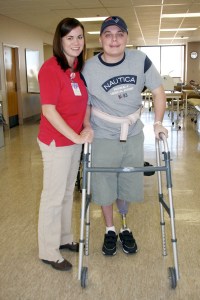
Shane is now able to breathe and eat on his own. He has also received a prosthetic leg from Methodist Orthotics & Prosthetics and is undergoing intense physical therapy to build up his strength so that he can progress to getting around with a walker.

It will be a long, hard road, but Shane remains optimistic about the future. He is working on completing his school curriculum and hopes to graduate from Ocean Springs High School next year.

“When this is all over,” he says, “I want to become a professional fisherman or a game warden.”

Genetic Testing Gives Women Options in Breast Cancer Treatment

Healthy Cells Magazine
October 2009

          No woman ever wants to learn that she has just been diagnosed with breast cancer.  But for thousands of women whose family medical history includes one or more relatives with the disease, the likelihood of developing breast cancer is a scary reality.  These high-risk women are two-to-five times more likely to develop the disease than women with no family history.  In the past, many of these women felt the situation was out of their hands.  However, today genetic testing has given them a proactive option to managing their health.

            Every year, nearly 200,000 women are diagnosed with breast cancer.  A very small percentage of these cases are known to be hereditary.  However, of the patients who do have hereditary breast cancer, 84% have been found to carry mutations in two genes known as breast cancer 1, early onset (BRCA1) and breast cancer 2, early onset (BRCA2).  Both genes are known as tumor suppressor genes, meaning they prevent cells from growing and dividing too rapidly.

            There are several risk factors that may indicate a BRCA gene mutation such as having a personal or family history of breast cancer diagnosed at a young age, history of breast cancer occurring in more than one generation, having a male relative with breast cancer, having a family member that has both breast and ovarian cancer, or having a family member with the BRCA mutation.  People with Eastern European or Jewish ancestry are also likely carriers. 

            A simple blood test can determine if a patient is a carrier.  Results are usually ready in 2-3 weeks.  A positive result does not mean that the patient has cancer.  Nor does it mean that they will in fact develop breast cancer.  But it does carry some significant risks.  “It’s a small number of patients that have breast cancer related inheritance, but if you have the mutation the risk of getting breast cancer is substantial,” says William Whitehead, surgeon with Hattiesburg Clinic.  “Eighty-seven percent of women before the age of 70 will get breast cancer if they’ve got the mutation.  Forty-four percent of women will have ovarian cancer if they have that mutation.  The risk of getting breast cancer in the opposite breast in the average patient is somewhere around 10-12% if they reach the age of 70.  But if you’ve got the mutation, it’s 10 times that.”

              Many patients may be apprehensive about the test because they are unsure of the next step should the results come back positive.  Dr. Whitehead suggests three options – surveillance, chemo prevention, or prophylactic surgery.  “If you are BRAC1 or 2 positive, you qualify with most insurance companies for a screening breast MRI after the age of 25.  Oncologists recommend one yearly after that,” said Dr. Whitehead. If cancer symptoms do appear, regular surveillance may be able to catch the disease during early stages and increase a patient’s chance for survival.  Hattiesburg Clinic’s Breast Center currently houses Mississippi’s only dedicated breast MRI and was recently named the state’s only Breast Imaging Center of Excellence. 

            Chemo prevention involves taking an anti-estrogen drug, such Tamoxifen, to reduce a patient’s risk of developing the disease.  A recent study conducted by the National Cancer Institute (NCI) found that high risk women without cancer who took Tamoxifen for 4-5 years decreased their chances of developing breast cancer by 45%.  Although taking Tamoxifen does have some associated side effects, many physicians agree that the benefits far outweigh the risks.

            The most extreme option is prophylactic surgery.  Actress Christina Applegate opted to undergo a double mastectomy in 2008 after being diagnosed with breast cancer.  Applegate had a family history of breast cancer and was also found to be a carrier of the BRCA 1 mutation.  After her surgery, Applegate announced that she was completely cancer-free.  “I had a patient whose mother and grandmother both had breast cancer,” relates Whitehead.  “Her mother’s disease had manifested itself in an advanced form of cancer in which she lost the battle; this patient didn’t want to take that risk.  If this is the option a patient wants to take, we can now perform immediate reconstruction.  This may help relieve the anxiety for those patients who have an unusually high risk for breast cancer.” 

            Even if patients have already been diagnosed with breast cancer, they may still want to consider having the test.  “Carriers of the gene have a 50% chance of passing it to their children and 25% chance of passing it to their grandchildren,” says Dr. Whitehead.  “I had a patient recently who had breast cancer and wanted the test.  She said that she wanted to do this for her sister, her daughters and granddaughters.”

            BRCA testing is available through Hattiesburg Clinic without a referral.  While most insurance carriers may provide coverage if a patient is deemed high-risk, it is still a good idea to talk to your insurance carrier about your individual policy.  For more information on BRCA testing, contact Hattiesburg Clinic department of surgery at 601-268-5660 or log onto www.hattiesburgclinic.com.

Surgery Offers Patients with Epilepsy a Second Chance at Life

Hattiesburg Clinic Digest, 2009

Kristin Lape entered her senior year at Mississippi State University with great expectations for the future – graduation, embarking on an exciting new career, and undergoing an operation that could change her life.  Lape, like over 3 million other Americans, suffered from epilepsy.

Lape experienced her first epileptic seizure at two years old.  By her senior year of college, she was having several episodes a day.  She was taking the usual round of anti-seizure medications; however, they were doing little to adequately control the disorder.  Lape’s mother voiced her concerns to a friend who in turn referred her to the neurology department at Hattiesburg Clinic.  Lape and her mother made an appointment to meet with Hattiesburg Clinic neurologist Dr. Wendell Helveston.

 “I still remember the day I walked into Dr. Helveston’s office,” recalls Lape.  “I was expecting him to either change my medication or increase my medication.  Dr. Helveston had been studying my medical files.  He said, ‘Kristin, we’ve got to get you fixed.  You are about to graduate from college.  You’re about to go out into the real world.  I think you would be a good candidate for surgery.’”  Dr. Helveston’s news came as both a shock and as a relief.  “I cried,” she says.  “I never had a doctor who pursued helping me that much.”    

Lape was admitted to Forrest General Hospital for preliminary testing.  With the use of an electroencephalogram (EEG), her electrical brain activity was measured to pinpoint the exact location in the brain that the seizures were originating from.  She was then referred to University of Alabama at Birmingham (UAB) for surgery.  Lape was wheeled into the operating room in December of 2006.  She has been seizure free for over a year. 

Before undergoing surgery, Lape describes herself as feeling, “tired a lot, lethargic, and drained.”  Since her surgery she has more energy and is able to be more active than she ever through she would.  Says Lape, “I recently went to a Trans Siberian Orchestra concert and it was amazing. Without my surgery, I know for a fact I would have had seizures within the first song. The light show was amazing, and it was great for me to be able to experience a concert without worrying about having seizures and not enjoy it.  That was a true test of the results of my surgery.”

Lape graduated from Mississippi State in May 2007 and is currently working as a graphic designer for Mojoloco, LLC in Brandon, Miss.  Although epilepsy no longer affects her life the way it used to, she has not forgotten that millions of Americans still live with the disorder everyday.  Last fall, Lape and the staff of Mojoloco volunteered their talents to help out the Epilepsy Foundation of Mississippi with their annual fundraising event.  They produced all the collateral materials and organized a team to walk the streets of Jackson on the day of the event to promote the fundraiser.  Lape received special recognition by the Epilepsy Foundation for her work.  Plans are underway to volunteer for this year’s annual event.  “It’s very rewarding to know that I am able to make a difference in people’s lives that are struggling with epilepsy just as I did,” Lape adds.  “I feel blessed to be able to make people aware that you don’t have to live with it for the rest of your life. Instead of being treated, it can be cured.” 


Screening Key to Detecting Early Childhood Hearing Loss

Prentiss Headlight, 6/17/2009

          Most of us associate hearing loss with getting older. We assume as we age that becoming “hard of hearing” comes with the territory.  However, many of us may not consider the effects of hearing loss in our younger generations, notably in newborns infants and young children.

            Hearing and speech are essential tools for normal child development.  Without these a child can grow up to have problems with speech and language development, experience isolation and social problems, and have academic difficulties.  The American Speech-Language-Hearing Association (ASHA) estimates that 1-6 out of every 1,000 newborns are born with some degree of congenital hearing loss.  This implies that hearing loss was present at birth.  At least half of these cases are attributed to heredity.  However other factors such as contracting an infection while in the womb, complications associated with the Rh factor in the blood, prematurity, maternal diabetes, toxemia, and lack of oxygen can also contribute to congenital hearing loss. 

          Early detection plays a significant role in combating problems that may arise later on.  In Mississippi, every newborn is required to undergo an ALGO hearing test before they are discharged from the hospital.  The ALGO test is a basic screening tool to detect congenital hearing loss.  If an infant passes the ALGO test, it is assumed that their hearing is normal.  However, if the test results come back abnormal, further testing may need to be done.

          “If an infant fails the test, it doesn’t necessarily mean that their hearing is abnormal.  It just means it needs to be verified with more in depth testing,” says John Sobiesk, MD, otolaryngologist with Hattiesburg Clinic’s Ear, Nose, and Throat Associates.  “We have two measures with which to verify our findings.  One test is called the ABR [auditory brainstem response] and the other is known as otoacoustic emissions [OAE].”

          ABR testing involves the use of electrodes to measure an infant’s brainwaves.  The electrodes are taped to the infant’s head and a series of clicking noises are made through a set of headphones in the baby’s ear.  A computer records the amount of time it takes for the brain to register the sound.  The clicks are presented at varying frequencies to determine the lowest volume the baby can hear.  The entire test takes about 15 minutes.  If the waveforms appear normal, the baby is considered to have normal hearing.  If they are abnormal, the physician may repeat the test or conduct an OAE to confirm their findings.

          During OAE testing, a small microphone is placed in the infant’s ear.  “There is an imperceptible sound generated by the nerve cells in the ear when we give the ear a clear sound,” explains Sobiesk.  “What we are looking for is a reflection of sound that will be given back from the ear.  In a person with a normal functioning ear, when I present sound in their ear, the ear will reflect an emission which I can register with a small microphone.”  The test takes about 6-8 minutes to complete.  It is very important that the infant is resting quietly while both tests are being conducted since noise or movement can skew the results.

          Even if an infant is determined to have normal hearing at birth, ear infections, damage to the auditory system, viruses, head injuries, and excessive noise exposure can lead to hearing loss as the child gets older.  Both the ABR and OAE test are useful in measuring hearing loss in older children and can be performed without a physician’s referral.

          If the infant fails both tests, a complete evaluation will be done to determine if the child has partial or total hearing loss, if they need to be fitted with hearing aids, and if the use of a speech language pathologist will be helpful in the development of the child’s speech, language, and cognitive communication.

          “Early intervention is essential for children.  An experienced speech language pathologist can evaluate the child’s speech and language development, and design a treatment plan based on the child’s individual needs,” said Martha Woodall, M.S., CCC/SLP, Speech Language Pathologist and Director of Education at Hattiesburg Clinic’s Connections.  “Children begin to learn language very early in life.  As they grow and develop, their language skills become increasingly more complex.  They learn to comprehend and use language to acquire knowledge and to communicate effectively with others.”

          For more information on infant hearing tests, please contact Hattiesburg Clinic Ear, Nose, and Throat Associates at 601-579-3310 or Ear, Nose, and Throat Associates – Lucedale at 601-947-9187.  For more information on speech pathology services, please contact Hattiesburg Clinic Connections at 601-261-5159.

####

Hattiesburg Clinic Neurosurgeon Shares Experiences of Life in War Zone

Feature story printed in:

Clarion Ledger, 8/11/2008
Hattiesburg American, 8/11/2008    

Original release printed in:
Lamar Times, 6/19/2008
Prentiss Headlight, 6/11/2008
Richton Dispatch, 6/12/2008

          For the average working American, our morning routines may consist of putting on a uniform or a suit and tie and grabbing that first cup of coffee before getting in our cars and driving to work.  However for the last three months, Dr. Richard Clatterbuck’s morning routine consisted of strapping on his army-issued rifle and grabbing a few rounds of ammunition before heading off to surgery. 

          Clatterbuck, a neurosurgeon at Hattiesburg Clinic and army reservist, spent 90 days on loan to the 332 Expeditionary Medical Group from Task Force 261 Spearhead Medics.  As part of this expeditionary medical group, Clatterbuck was assigned to the Air Force Theatre Hospital in Balad, Iraq.  “A lot of the military medical operations that are happening now are a collaboration between people,” explains Clatterbuck.  “The Air Force doesn’t have enough neurosurgeons and the Air Force hospital needed neurosurgical expertise.  The Army put neurosurgeons there as part of a cooperative function.” 

          Clatterbuck received the call last summer that he would be going overseas.  Like any solider leaving behind a life and family to serve their country, he had his concerns.    “The first thing I worried about was my wife,” he says.  “And then I worried about having to leave the practice.  My partners would have to pick up the calls and cover my patients.”  However, Clatterbuck says he didn’t spend much time worrying about the dangers he could face when he finally touched down.  “There is certainly some anxiety and concern about going to a combat zone.  But quite honestly, I didn’t lose any sleep worrying about that part.  It’s not the same kind of sacrifice as people who are out there on the frontlines.”

          Before Clatterbuck touched down in Iraq, he had to go through 10 days of conditioning and training to prepare him for life in the desert.  His training consisted of becoming familiar with the Iraqi culture in addition to weapons training and how to recognize exploding devices.  After a week of intense training stateside, Clatterbuck was sent to Kuwait for three days for more weapons training before being sent to Iraq. 

          Clatterbuck describes life in an Iraqi operating room as “brief episodes of sheer terror and adrenaline punctuated by periods of boredom.”  Being fairly close to the battlegrounds, he experienced a few rocket attacks that exploded less than 150 yards from the hospital.  He attributes some of his most memorable experiences to saving the lives of a few severely injured Iraqi children.  “There were a couple of kids who came in with bad head injuries and looked like they were going to die who walked out of the hospital a couple weeks later.”  However, Clatterbuck also adds, “Day in and day out it was just being a neurosurgeon much like being a neurosurgeon over here.  A lot of what I did was very routine kind of stuff and sometimes you were just sitting around waiting for something to happen.” 

          Overall, Clatterbuck describes the area where he was stationed at as being comfortable.  “I had air conditioning.  I had Armed Forces Network Cable television so I could see football games, basketball games, baseball games, American Idol, whatever was on TV,” he says.  “There was a Burger King there, a Popeye’s Fried Chicken, a Taco Bell, and a Subway. They did what they could to make it as pleasant as it could be.”  But three months away from your family and friends can make even the most seasoned solider long for home.  “I missed seeing grass and water because there was none of that.  We had very few trees and we didn’t have much rain.”   Clatterbuck also longed from some good old Mississippi gulf coast seafood.  “When I first got back to Hattiesburg the very same day I went and had some oysters.  I was dying to have some catfish and have some oysters.” 

          When asked to sum up his experience Clatterbuck says, “I am very glad I went.  I’m very proud of serving my country.  Medical personnel are something the military desperately needs – there are not enough well-trained surgeons to support the mission.    At the same time, seeing all those people coming in with such severe injuries is not a pleasant experience as a surgeon.  Things are better than they were but it’s still very difficult for the people who live there.  But if they called and told me I needed to go back again I would.” 

####

Primary Care Providers Key to Healthy America

Featured in Stone County Enterprise, 3/18/2009 

          The United States prides itself on being a leader in advanced medical technology.  Our country houses many the best medical schools, specialty care dominates our system, and we have managed to inoculate ourselves from several serious life-threatening diseases that still continue to kill people in third-world countries every day.  However, you may be surprised to learn that in comparison with other developed countries, America’s health is relatively poor.  The average life expectancy for both men and women in the United States is significantly lower than those in Europe, despite the fact that American’s smoke and drink less than their European counterparts.  Even higher income citizens with access to adequate health coverage still have lower life expectancies.  One key fact that may be contributing to this dilemma – more and more Americans are choosing to bypass primary care providers and instead opting to self-diagnose and self-refer to medical specialists.

            A primary care provider (PCP) is a practitioner that is trained to diagnose and treat minor injuries and illnesses, manage long-term chronic illnesses, and determine when a patient’s condition warrants seeing a specialist.  These include Internists, Family Practice Physicians, Pediatricians, Obstetrics & Gynecology Physicians, and Nurse Practitioners.  PCP’s are often referred to as “gatekeepers” to your health plan.  PCP’s know your family history, what prescriptions you are taking, and previous and current medical conditions.  By taking all these factors into consideration, they are often better able to provide a more appropriate treatment plan.  “As patients get older, they need to have someone to coordinate their care.  They need someone who is looking out for the entire person rather than just each specific disease that they might see a specialist for,” says Brian Batson, MD, internal medicine physician and director of the Hattiesburg Clinic Hypertension Center of Excellence.  “As our population ages, we have a lot more people that are Medicare-age patients.   Even though they may have a heart doctor and a blood pressure doctor and a kidney doctor, they always need to maintain that ongoing relationship with a primary care doctor.”  While establishing that relationship with a PCP is crucial for older patients, it is equally important that younger patients do so as well.  “Patients need to establish a relationship before they are on Medicare.  They need to establish it when they are in their 30’s and 40’s so we can prevent these diseases that occur when they do get older,” adds Batson.  “So much of what we do in medicine in younger patients is preventative care.  If we can start the ball rolling at a younger age they may not have all these complications by the time they are older.”

            Establishing a relationship with a PCP early has shown in numerous studies to provide a variety of benefits such as reduced healthcare costs, reduced hospitalization rates, reduced mortality rates, and better quality of care.  Forty-one percent of all specialist referrals are made by the patients themselves.  Of that total, 60% referred themselves to the wrong specialist.  This can result in a gamut of doctor’s visits and tests that may or may not lead to an effective diagnosis and treatment.  According to a recent review conducted by the American College of Physicians (ACP), one PCP per 10,000 patients can reduce inpatient admissions by 5 percent, outpatient visits by another 5%, emergency room visits by 10 percent, and surgeries by 7 percent.  The study also reveals that the United States utilizes primary care less than any other developed country, yet we spend more on healthcare with less effective outcomes.  While medical specialists do play an important role in healthcare, they are often more effective when treatment is orchestrated through a primary care provider. 

            The ACP also cites several studies that indicate an increase in the supply of PCP’s for a geographical area can reduce mortality rates.  According to the Mississippi Department of Health (MSDH), both Forrest and Lamar counties have higher physician-to-patient ratios than the statewide average.  Both counties also have a lower mortality rate statewide for the three leading causes of death – heart disease, cancer, stroke, and accidents.

            Hattiesburg Clinic is committed to the health of South Mississippi and employs more than 70 primary care providers.  The Clinic has primary care offices in several locations,  including Hattiesburg, Collins, Columbia, Ellisville, Petal, Picayune, Poplarville, Prentiss, Purvis, Seminary, Sumrall, and Wiggins.  For more information and a complete listing of primary care providers, please log on to http://www.hattiesburgclinic.com.

PET CT Effective Tool in the Diagnosis and Treatment of Colon Cancer

Lamar Times
6/25/2009

Colon cancer is the second-leading cause of cancer-related deaths in the United States.  In 2006, 148,000 people were diagnosed with the disease, with both men and women being diagnosed in equal numbers. However, colon cancer is one of the most preventable cancers because it can develop from polyps that can be removed before they become cancerous.  If diagnosed early, colon cancer is curable with a 90% success rate.

“Colonoscopy has helped in early diagnosis, as well as in prevention of malignancy by removal of polyps prior to them becoming malignant,” says Nagen Bellare, MD, oncologist with Hattiesburg Clinic.  “Adjuvant chemotherapy has also decreased the chance of recurrence in a large group of patients.”  However, approximately one-third of patients treated for colon cancer may develop a recurrence.  PET (Positron Emission Tomography) scans are an extremely useful tool for detecting the recurrence of colon cancer in patients.

Earlier imaging devices lacked the sensitivity required to determine if a mass was cancerous or was caused by scarring from previous surgical or radiation treatments.  Over the years, PET has proven to be more effective than CT in determining if an abnormality is cancerous,  or if the cancer has spread,  and is used to evaluate tumor response to treatment.  It may prevent unneeded surgery,   as reported in a recent study published in the Journal of Nuclear Medicine. The use of a PET scanner to evaluate the extent of the disease resulted in a change in the treatment plan in more than half of the patients included in the study.  Though most patients who live more than five years without a recurrence are considered cured, physicians should include PET as part of their patient’s regular testing.

Hattiesburg Clinic houses the Pinebelt area’s only permanent PET/CT as part of its fully accredited Department of Imaging.  Hattiesburg Clinic is the only facility in the state with an American College of Radiology (ACR) accredited PET scanner system.  The PET/CT is available to patients Monday – Friday from 8 a.m. – 4 p.m.  Referrals can be made by calling the Hattiesburg Clinic scheduling desk at (601) 579-5120.

Hattiesburg Clinic Physical Therapists Utilize New Form of Treatment: Wiihabilitation

Feature story printed in:
Hattiesburg American, 8/05/2008
PT Moments, Fall 2008

          Eight-year-old Allison Ratliff, like most children her age, enjoys playing sports.  Right now, she is very enthusiastic about baseball.  “It’s so much fun,” Ratliff says.  “It’s really fun to bat.”  However, as Ratliff tells about her love for America’s favorite pastime, she’s not sitting in the dugout of a baseball diamond.  She’s standing in front of a television set in the physical and occupational therapy department of Hattiesburg Clinic.

            Ratliff, who broke her leg earlier this year and is undergoing physical therapy to strengthen her knee, is one of many physical therapy patients who have been participating in a new form of rehabilitation that some users have come to refer to as “Wiihabilitation.”  The therapy utilizes the Wii (pronounced we) video game console.  Released by Nintendo in late 2006, the console features a wireless remote controller that can detect movement by its user.  Instead of sitting in a chair only exercising your thumbs, Wii users actually have to interact with the game.  As with Ratliff and her baseball game, in order to hit the ball she has to swing her arms as if she’s swinging a bat.  “Playing the Wii helps me with my knee,” Ratliff adds.  “After you throw the ball you have to hop two times.  I couldn’t do that before and now I can.”

            Hattiesburg Clinic purchased the console earlier this year.  The Wii comes with a game called Wii Sports that requires users to mimic the motions used in various sports such as bowling, tennis, boxing, baseball, and golf.  The console began gaining notoriety shortly after its release when users began reporting sore muscles after playing the games – much like spending a day at the gym.  Physical therapists around the country took notice.  “Some of our patients were playing with it at home and reporting a lot of positive feedback,” said certified sports specialist Clint Hudson, PT.  The Clinic recently added a new program called Wii Fit in June.  The program comes with a balance board that allows users to do yoga, play balance games, do strength training, and even aerobics.  Army E4 Specialist Willie Lindsey is now in his fifteenth week of therapy at Hattiesburg Clinic after undergoing surgery to replace his ACL.  Lindsey recently tried out the new balance board during one of his therapy sessions.  The console evaluated his center of gravity as he pretended to snow ski, did lunges, tried out a few yoga poses, and even balanced on a tightrope.  “I have really been working to regain my balance since my surgery,” relates Lindsey.  “I have done strength training, balance training, and running as part of my therapy.  But the Wii has helped me with my balance more than anything.” 

            Hattiesburg Clinic is not just using the Wii to treat younger patients.  “There are a lot of activities that interest different people,” says Maxie Manning, PT.  “We can treat a lot of different patients with different conditions.”  Joyce Bain is an amputee who has been walking with the use of a prosthetic leg since 2004.  “When I got my prosthesis a therapist had to help me learn to walk on it while using crutches and then a cane and then without the help of either one,” explains Bain.  “Now that I can do that, I have to work to keep my lower body strength up.” 

            “She loves to come in here and play the games,” Manning adds as she observes Bain playing the bowling game.  “It makes her shift her weight and she’s having fun while she’s doing something therapeutic.” 

            Tommy Speed agrees.  Speed sustained knee and shoulder injuries in an automobile accident and has been playing the bowling game to help build muscle strength.  “I have really noticed an improvement in my condition,” says Speed.  “You don’t think about the pain as much.  It’s easier that your mind gets involved in the game.  You don’t feel like you are doing therapy.”

            Hattiesburg Clinic currently offers physical and occupational therapy at four locations — in the main Hattiesburg Clinic facility and in satellite clinics in Petal , Purvis, and the Lake Serene area.  For more information on Hattiesburg Clinic physical and occupational therapy services, please call 601-268-5757.

####

Caption Photo 1: Physical therapy patient Allison Ratliff tests her hula hoop skills on Hattiesburg Clinic’s Wii video game console as physical therapy student Alisha Farrish looks on.  Hattiesburg Clinic has begun using the Wii as a new treatment for patient rehabilitation.

 Caption Photo 2:  Army E4 Specialist Willie Lindsey performs lunges on Hattiseburg Clinic’s Wii Fit balance board as part of his physical therapy treatment.  Hattiesburg Clinic has begun using the Wii video game console as a new treatment for patient rehabilitation.